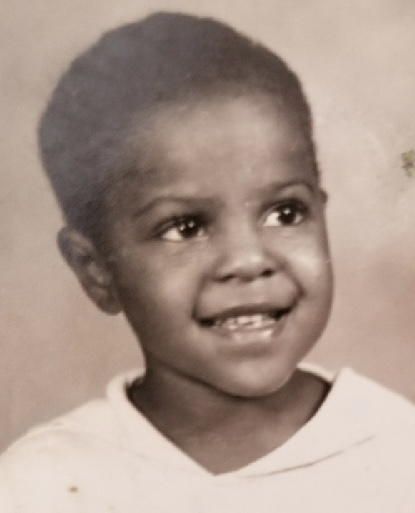
An Autobiography of Dr. Deorsey Earl McGruder, Jr., An African-Cherokee American (born 1937 and written at age 49)
This series includes excerpts from an autobiography by Dr. Deorsey Earl McGruder, Jr., an African Cherokee veterinarian from Oklahoma, written in the 1970’s. He reflects on life experiences and shares his wisdom.
“I don’t know if I was a handsome young boy. How much I weighed or if I had hair. You see, I was probably (back in those days) delivered by a midwife. Over the months, I grew. I imagine I started growing hair. I had a good grade of hair, at the time becoming curly.
My grandmother, Elizabeth Burton, was happy that I was here. She was actually my father’s auntie. His mother passed when he was 4yrs old in Alabama; so she raised him as her own son in Muskogee, OK. She gave him everything. They owned a store when he was growing up. I was told he was the best-dressed boy in Muskogee. She probably spoiled him to try to make up for the loss of his mother.
When I was very young, probably just walking, I was enterprising at the time. I used to make money singing. I remembered being at my grandfather’s house on North Third. People would give me pennies and nickels to hear me sing, “Mama’s lil boy like shortening bread.” I think I was also dancing.
We lived in the country, and at least once a week we would eat at my grandmother’s house on Altamont Street right after church, then we would go to B.T.U. Every Sunday, Mama Burton’s sister, Mrs. Mosley, would give me a white handkerchief. Come to think of it, it might have been the same one, but washed. One Sunday, I got into a bottle of black draught. It was good tasting medicine, but a laxative. You talk about someone being messed up! Needless to say, that was me (and I probably didn’t go to church that Sunday). Every Sunday I would keep my clothes on all day.
During the years of going to school, my grandfather (on my mothers side) would plow, harvest, and plant the fields. His name was Learner Munroe Seals. I called him, “Pawpaw.” He would come out to the house on 34th Street early in the morning and stay ‘til dusk. He had to leave before dark because he was traveling by wagon. {Horses pulled the wagon.} The distance he traveled everyday was roughly 30 blocks. I cannot estimate how long it took to travel by wagon. In those days, you didn’t worry about time — only when to eat. It probably took about 2 hours to go that distance. He would go around the back way — away from traffic. However, there weren’t many cars in those days.
I would get up early in the dawn to till the soil. I would follow my grandfather up and down the rows being plowed. The smell of the freshly plowed field was like a sweet fragrance of rose. Most of the field was plowed in early spring. You could hear the chirping of the birds — robins in the air. The two-toned color of the robin red-breast and brownish feathers were a pretty sight.
I wasn’t the only one following the freshly plowed rows in the fields. The birds followed too; plucking the worm that was recently plowed. You could see the larger birds flying into a nearby tree feeding the little ones. You could see several mouths opening ready to be fed.
Being that young — I don’t know how long I was with my grandfather called,” Pawpaw,” in the field. But, I do know it was a delightful sight to see my grandfather reach for the dinner bucket. It was black in color and it’s hinges began to turn color due to using it for a long period of time. When he opened the bucket you could smell the fragrance of dinner (lunch). The lunch usually consisted of biscuits, bacon, eggs and onion.
Whenever I needed a haircut, in his lunch bucket he would have a pair of scissors and clippers. Right after dinner he would rub my head and (like a bolt of lightning) I would be asleep. The clippers in those days were manually operated for he would be on the back porch cutting my hair. As the cool breeze of the wind would catch my hair, it would sail through the air like a leaf from a tree. Needless to say, my head felt cooler.
During the period of time when grandfather was plowing the fields in the morning, the afternoon was left for the freshly plowed fields to be harrowed. It was a large metal instrument that the horses pulled. The harrow would cover 2 rows at a time. If you wanted to break the clods of dirt, you would put a piece of board on the harrow and ride it. Your weight would break the clods into small portions.
Next, the ground was ready for planting. After being with my grandfather, I thought all of this would be easy. One day, my grandfather was away from the field, because he went to the outhouse. I got onto the horse and grabbed the rings with my small hands and said, “Gitty up!” They only knew that one command, and much to my surprise, we were on our way to the other end. I thought I was doing a marvelous job. I couldn’t see the rows, because of being so small.
When my grandfather came back and saw what I had done, he was furious. I didn’t realize the difference in his plowing and mine. My rows were very crooked, probably by not holding the reins with both hands. Equal pressure was needed on the reins. If you don’t the horses will go either right or left. He said, “If you were big enough to work, I couldn’t find you.”
I imagine, I would have been mad. He would have to have backed up the horses and pull the plow back. He did this about 50 ft. You can imagine how far he had to go from one end of the row to another in order to have a complete row, and for all rows to be straight. There was no way to stop in the middle of the row. However, for as long I can remember, I continued to trail him until it was time for me to start school.”
 African-Cherokee American Genealogy Blog
Leave a comment